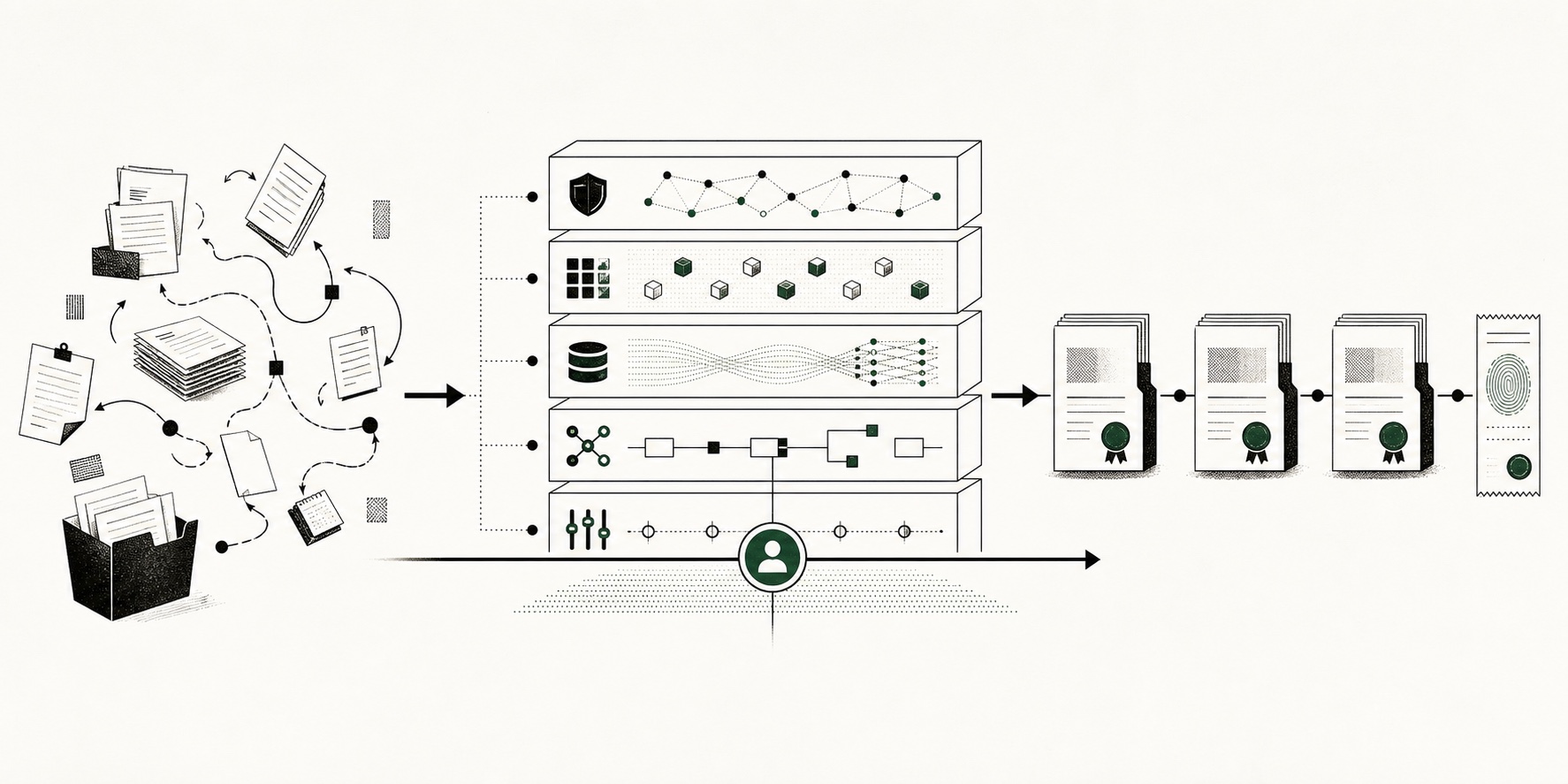
We study one recurring workflow, define what AI may prepare, keep accountable decisions with people, and build the records and controls needed to review each handoff in scope.
Describe one recurring workflow. Mark the work AI may prepare, the decision a person must retain, and the evidence the next reviewer needs. The result is a draft for discussion—not an automated assessment.
START FROM A PATTERN
02 · HANDOFF INSPECTOR
Change the worker. Keep the decision trail.
This documented example demonstrates the handoff fields; it is not a customer result. Switch workers to inspect which decisions, boundaries, and pending checks travel with the task.
INSPECTABLE HANDOFF RECEIPTRefactor the checkout retry path
DOCUMENTED EXAMPLE
→
Claude Code is the current worker. Select Codex to inspect the handoff.
CONTEXT CARRIED
DecisionRetry at the service boundary
Changed filesCheckout service + focused test
Remaining workRun the targeted verification
BOUNDARIES PRESERVED
File scopeCheckout path only
External actionNo deploy or customer message
ApprovalRequired before release
CHECKS BEFORE RELEASE
01Focused testTO RUN
02Diff reviewTO REVIEW
03Release approvalNEEDS APPROVAL
03 · AGENT INFRASTRUCTURE
We add the workflow controls a model prompt does not define.
Models can draft, classify, compare, and call tools. The Lab works on what surrounds those steps: context, scope, ownership, exception paths, approvals, and the record that reaches the next reviewer.
01
Observe
Name the repeated failure, its owner, the inputs it needs, and the measure worth improving.
02
Bound
Separate stable steps from approvals, exceptions, commitments, and decisions that remain human.
03
Prove
Keep the scope, handoff, checks, and next decision in a record another person can review.
For accountable owners
See where automation stops before it creates an accountability gap. Start with one failure and one measure.
For workflow operators
Turn scattered inputs, handoffs, and exceptions into work another person can inspect and resume.
For engineering and platform teams
Add memory, bounded execution, and review evidence without forcing every team into the same workflow.
PLATE 02 / AGENT OPERATING RECORDMemory, context, execution, and proof meet in one review surface.
WORKFLOW RECORD
Owner
Who is accountable now
Scope
What this run may touch
Exception
What left the stable path
Approval
Which decision stays human
Measure
What the review will examine
A/01
Agent continuity
Can another worker resume without rebuilding the intent?
Shared task memory, bounded file scope, decisions, pending checks, and handoff state across tools and sessions.
Can repeated work survive exceptions, owners, and approvals?
A workflow record with its owner, checkpoints, exception path, approval, and next review.
Review record: checkpoint, exception, approval, next action
PROCESS PLATE / MANUAL → BOUNDEDANNOTATED WORKFLOW
Inputs collectedStable steps boundedHuman approval retainedReceipt produced
04 · EVIDENCE BENCH
See what was measured—and what was not.
A result appears here only with its baseline, fixture or dataset, method, controls, and limits. When the evidence is not current enough, we show the validation state instead of recycling the number.
VERIFIED FIXTURETETRIS.CODES · 27 JUL 2026
6,003 → 999estimated input tokens
Inspect what the selector did—and what it refused to do.
Four deterministic fixture states show reduction, passthrough, and refusal as separate outcomes.
01One function6,003 → 999
Baseline
Full generated large-Rust fixture read
Decision
Use an outline for one focused function task
Output
999 estimated input tokens
Limit
No end-to-end task-quality measurement
02Small fileKEPT WHOLE
Baseline
Small input already fits the task
Decision
Do not compress
Output
Full input passes through
Limit
Passthrough is the tested control, not a saving
03Generated bundleDENIED
Baseline
Generated bundle fixture
Decision
Deny in strict mode
Output
No compressed payload
Limit
Fixture refusal; not a universal security guarantee
04Security-sensitive inputVERBATIM
Baseline
Security-sensitive auth fixture
Decision
Keep tested input verbatim
Output
No eligible tokens compressed
Limit
Tested control; not a claim about every sensitive input
Inspect the test methodcargo test -p tetris-bench --test atlas_savings_report --test coverage_adjusted_bench -- --nocapture
14 fixture checks passed on 27 July 2026.
Fixture benchmark. It does not claim end-to-end task quality or provider latency.
The existing benchmark artifact targets an older release and does not record enough environment and repeated-run detail to present as a current Nexus Prime result.
Measures
Token planning, memory store and recall, retrieval quality, bootstrap context
Start with the operating pattern, not the industry label.
Choose the pattern closest to your work. These are design examples, not claims of customer deployments. Every implementation begins with domain experts, operating boundaries, and named human approvals.
Case history, account or vendor records, policy, current owner, and escalation rules.
Bounded AI work
Assemble context, draft next actions, chase required inputs, and route ownership.
Human decision
Policy, tone, commitments, exceptions, and escalations.
Reviewable output
Case brief, named owner, next action, and escalation record.
Measure to agree
Ownership gaps and unresolved-exception age
06 · WORK WITH THE LAB
Bring one workflow. Leave with a reviewable boundary.
Start with the repeated work, the person accountable for the outcome, the point where it breaks, and the decision that must remain human. Scope, access, safeguards, deliverables, timing, and one measure are agreed before any pilot begins.
BEFOREOwner, scope, AI boundary, approvals, access
DURINGCurrent owner, exceptions, pending checks
HANDOFFA record another person can review
07 · BENCH INSTRUMENTS
Use the system that matches the constraint.
Two systems have public install paths. Three are in private development and are discussed only when their capability fits the workflow.
01 · control planePUBLIC · INSTALL
Nexus Prime
Carries decisions, context, and review gates across coding-agent sessions.
Decide where the boundary belongs before you automate.
What is a bounded AI workflow?
It is a workflow whose inputs, AI-run steps, required approvals, exception path, owner, and review record are defined before it is put into use.
What does custom workflow creation include?
It starts with the trigger, failure point, accountable owner, safe AI-run steps, human decision, exception path, review evidence, and one measure. Architecture and integrations follow only after that boundary is agreed.
What happens when I submit the pilot form?
The site opens a draft in your email client. Nothing is transmitted by the form or sent until you review and send the email. Do not include credentials or sensitive records.
How do we start without a large AI transformation?
Start with one recurring workflow, one owner, and one measure. Review the operating boundary before adding integrations or automating more steps.
What does a workflow review require?
Bring a process description, the current owner, safe sample artifacts, the approval path, and the failure or delay to improve. Sensitive access is agreed only after scope and safeguards are clear.
Which decisions should stay with people?
People retain regulated approvals, commitments, exceptions, and decisions that require judgment or accountability. AI can prepare evidence and run agreed steps without taking that authority.
Which Nexus-PRIME systems are publicly available?
Nexus Prime and tetris.codes have public install paths. Grain, NXL, and Phantom are in private development; fit and availability depend on the workflow and its review requirements.
Can this approach support healthcare work?
The relevant starting points are administrative workflows such as referral intake, missing-document checks, and care-coordination handoffs. Clinical decisions remain with qualified professionals, and the organization defines privacy, security, and regulatory requirements.
How does the Lab decide whether a benchmark belongs on this site?
A result must name its baseline, fixture or dataset, version, method, controls, and limits. Results that depend on hardware or providers also need environment details and repeated-run variance. Otherwise the page shows the protocol, not a marketing number.
NEXT ACTION
Bring the workflow that keeps creating rework.
We will find the smallest useful step, the human decision boundary, and the evidence needed to review it.